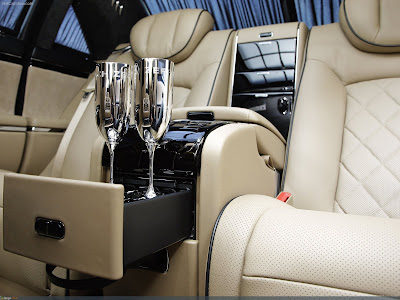
The Maybach brand is bringing out the new Maybach Zeppelin to spearhead its luxury saloon model range. The new model, which is receiving its premiere at the Geneva Motor Show, represents the absolute zenith in the high-end luxury saloon segment. This makes it a worthy successor to the legendary Maybach Zeppelin, which was revered worldwide as the ultimate in high-class automotive engineering in the 1930s. The hallmark features of the new Maybach flagship's unique sense of style include a stunning paint finish, featuring a shoulderline in a contrasting colour, as well as the exquisite, meticulously crafted materials in the interior, whose long list of optional extras includes a world first - a highly sophisticated perfume atomiser. The new model's performance even outclasses the rest of the Maybach range, making it the most powerful Maybach ever. In a nutshell: the Maybach Zeppelin epitomises stylish elegance and the art of vehicle manufacture at its most refined as no car has ever done before. The new Maybach Zeppelin is being built in a limited edition of just 100 worldwide.
Even today, the name "Zeppelin" has an incomparable ring to it in the realm of high-end luxury cars. As in bygone times, Maybach is once again building the Maybach Zeppelin for drivers who are seeking something extra special, even in this most luxurious of automotive segments. Not only do the Maybach 57 Zeppelin and Maybach 62 Zeppelin stand out for their exquisite elegance, inventive ideas and phenomenal performance, only one hundred of these special model versions of the high-end luxury saloons will be made worldwide.




 Presented by Mega-Wall Blogger
The Ford GT features many new and unique technologies, including super-plastic-formed aluminum body panels, roll-bonded floor panels, a friction-stir welded center tunnel, a “ship-in-a-bottle” gas tank, a capless fuel filler system, one-piece door panels and an aluminum engine cover with a one-piece carbon-fiber inner panel.
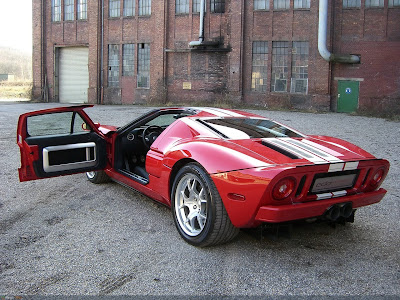
Brakes are four-piston aluminum Brembo calipers with cross-drilled and vented rotors at all four corners. When the rear canopy is opened, the rear suspension components and engine are visible.
The 5.4L Modular V8 powerplant is all-aluminum and fed by a Lysholm twin screw-type supercharger. It features a forged rotating assembly housed in an aluminum block designed specifically for the GT program. A dry sump oiling system is employed, allowing the engine to sit very low in the frame. The DOHC 4-valve heads are a revision of the 2000 Ford Mustang SVT Cobra R cylinder heads (with slightly increased wall casting thickness in the exhaust port). The camshafts have unique specifications, with more lift and duration than those found in the Shelby GT500 or 2003–2004 Ford Mustang SVT Cobra. Power output is 550 horsepower (410 kW) and 500 foot-pounds force (680 N·m) of torque. A Ricardo six-speed manual transmission is fitted featuring a helical limited-slip differential.
Performance:
* 0–60 mph (0–96 km/h): 3.3 seconds
* 0–100 mph (0–160 km/h): 7.4 seconds
* Standing 1/4 mile: 11.2 seconds @ 131.2 mph (211.1 km/h)
* Top speed: 205 mph (electronically limited)
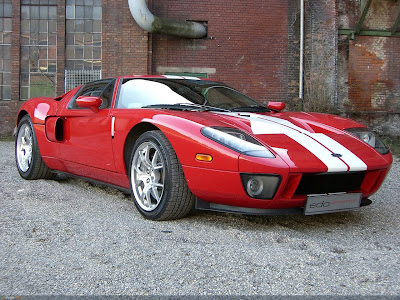
The Ford GT is a mid-engined supercar. It was built by Ford Motor Company from 2003 to 2006. It began as a concept car designed in anticipation of Ford's centennial year and as part of its drive to showcase and revive its "heritage" names such as Mustang and Thunderbird. Camilo Pardo, the head of Ford's "Living Legends" studio, is credited as the chief designer of the GT and worked under the guidance of J Mays. The designers drew inspiration from Ford's classic GT40 race cars of the 1960s and the GT is sometimes mistaken for its 1960s counterpart.
Positive response on the auto show circuit in 2002 helped persuade the company to produce the car in limited quantities, and the first production versions appeared in 2005. It is a very high-performance, two-seater vehicle with a strong styling resemblance to its racing ancestor and performance to match. The powerplant is a mid-mounted supercharged 5.4 litre V8, producing 550 horsepower (410 kW) and 500 foot-pounds force (680 N·m). Top speed is 212 mph (341 km/h).





 Presented by Mega-Wall Blogger


